
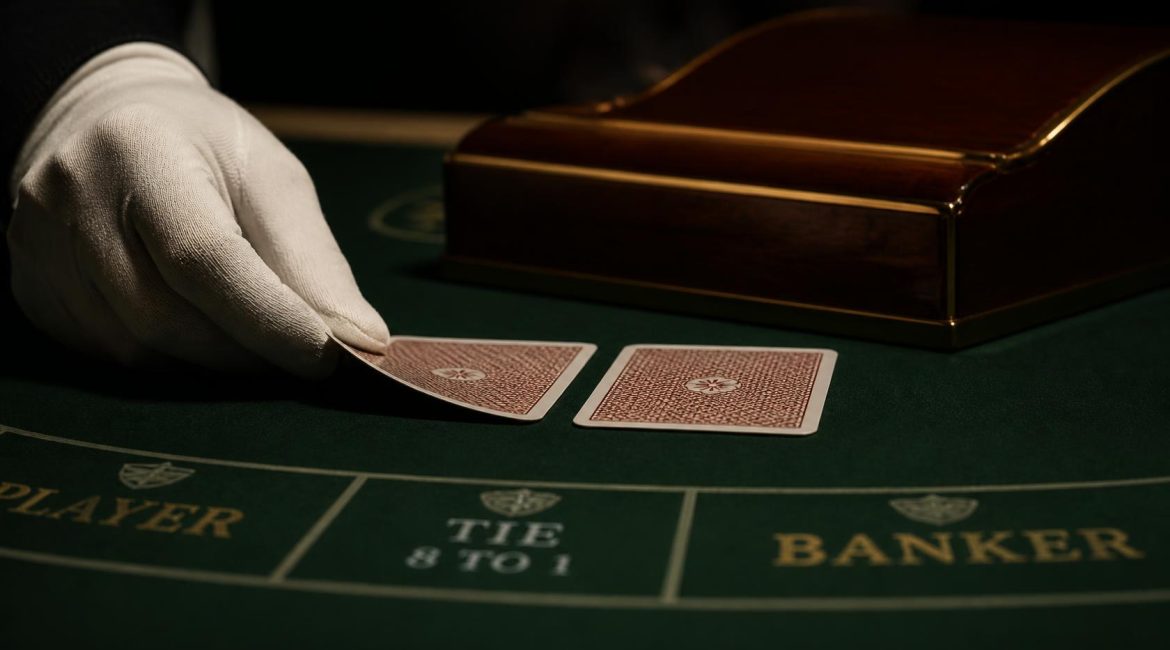
Baccarat looks more complicated from outside the table than it feels once a round begins.
You do not decide whether either hand draws another card. You do not choose how the hands are played. The dealing procedure follows fixed rules from beginning to end.
Your main decision comes before the cards appear:
Banker, Player or Tie?
Those three bets do not carry the same mathematics, which is the part of baccarat worth understanding.
Player and Banker are names for the hands
Every standard baccarat round contains two hands:
- Player;
- Banker.
Those labels can be misleading.
The Player hand is not “your” hand, and the Banker hand does not belong to the casino.
They are simply the names of the two positions dealt on the table.
You are free to bet on either one.
A third option, Tie, pays when both hands finish with the same total.
How baccarat card values work
Baccarat uses a simple scoring system.
Aces count as 1.
Cards from 2 to 9 use their face value.
Tens, jacks, queens and kings count as 0.
If the cards total more than nine, only the final digit remains.
For example:
7 + 5 = 12, so the hand value is 2.
9 + 6 = 15, so the hand value is 5.
There is no bust.
The highest possible hand value is 9.
What is a natural?
A two-card total of 8 or 9 is called a natural.
If either hand receives a natural, the normal drawing process stops.
No third card is required.
This is one of the few baccarat rules worth recognising immediately because it explains why some rounds end almost as soon as the first four cards are revealed.
Why the third-card rule looks complicated
The third-card table is the rule that gives baccarat its reputation for complexity.
The good news is that the player does not have to use it.
The dealer or game software applies the drawing rules automatically.
The Player hand acts first.
If its total is:
- 0–5: it draws;
- 6–7: it stands;
- 8–9: it has a natural and the round ends.
The Banker’s drawing rule can depend on both its own total and, when relevant, the value of the Player’s third card.
That produces the large chart often shown in baccarat guides.
Understanding the chart can explain how the game works.
Memorising it will not improve your decision-making because you never choose whether the card is drawn.
Why Banker wins slightly more often
The Banker’s drawing procedure gives that hand a small structural advantage.
Because its rule can react to the Player’s third card, Banker finishes ahead slightly more often.
That is why traditional baccarat normally charges a commission on winning Banker bets.
Without an adjustment, the bet would be unusually favourable compared with the casino’s intended margin.
Banker bet: the lowest standard house edge
In conventional baccarat, a Banker win usually pays 1:1 minus a 5% commission.
After that commission is included, the house edge is approximately 1.06%.
That makes Banker the lowest-edge standard wager on a typical baccarat table.
The commission therefore does not make Banker mathematically worse than Player.
It is the mechanism used to reduce the advantage created by the drawing rules.
Player bet: close, but slightly behind
The Player bet normally pays even money and does not carry a commission.
Its house edge is roughly 1.24%.
That difference from Banker is relatively small.
Both main bets are therefore far closer mathematically to one another than either is to the Tie bet.
If the distinction between RTP and house edge is unclear, our guide to house edge and RTP explains how these percentages describe the long-run cost built into casino games.
Why the Tie bet is different
The Tie bet can look attractive because of its larger payout.
A standard table may offer 8:1.
The problem is that the probability is much lower than the payout needs to compensate for.
At an 8:1 payout, the house edge is roughly 14.36%.
Some tables pay 9:1, which improves the mathematics considerably, but Tie remains much more expensive than either Banker or Player.
This is why it should not be treated as a harmless side option.
The larger potential payout comes with a much larger underlying disadvantage.
The three bets are not interchangeable
On a conventional table, the rough comparison is:
| Bet | Typical payout | Approx. house edge |
|---|---|---|
| Banker | 1:1 minus 5% commission | 1.06% |
| Player | 1:1 | 1.24% |
| Tie at 8:1 | 8:1 | 14.36% |
These figures explain almost everything a player needs to know before choosing among the three basic bets.
The difference between Banker and Player is small.
The jump to Tie is not.
What is No Commission Baccarat?
Some baccarat tables remove the standard 5% Banker commission.
That sounds automatically better, but the rules compensate elsewhere.
A common version pays only half the normal amount when Banker wins with a total of 6.
Other versions can use different adjustments.
Do not assume that “no commission” means lower house edge.
Read the exact table rules and payout schedule first.
Speed Baccarat changes pace, not the rules
Speed Baccarat shortens the time between rounds.
Card values and drawing rules remain the same.
What changes is exposure.
If more hands are completed every hour, you can wager more money over the same period even when your stake per hand stays unchanged.
The house edge is still a percentage of the amount wagered.
Faster play gives that percentage more opportunities to operate.
Squeeze Baccarat changes presentation
Squeeze Baccarat moves in the opposite direction.
Cards are revealed more slowly and the presentation creates suspense around each result.
The core mathematics remain the same when the underlying rules and payouts are unchanged.
The slower reveal does not make any outcome more or less likely.
It changes the experience, not the probability.
What do baccarat scoreboards tell you?
A baccarat table often displays previous Banker, Player and Tie results in grids sometimes called roads.
The records are accurate descriptions of previous hands.
They are not predictions.
A streak of Banker wins does not prove that Banker will continue.
It also does not make Player “due”.
The next round follows the game’s dealing rules rather than a need to balance the visual pattern displayed on the screen.
Why streak systems fail
Random sequences naturally contain streaks.
That is why a scoreboard can look as though patterns keep appearing.
The problem comes when the pattern is treated as predictive.
Changing your bet because four previous hands were Banker does not change the mathematical structure of the next hand.
The same applies to alternating patterns or systems built around previous colours and symbols on the roadmap.
They organise historical information.
They do not change the edge.
Betting progressions cannot remove the house edge
Systems such as increasing the stake after a loss affect bet size.
They do not alter the underlying probability.
Doubling after a loss, for example, can produce many small recoveries followed by a much larger loss when the losing sequence continues.
Table limits and finite bankrolls also prevent the progression from continuing indefinitely.
The casino edge applies to each unit wagered regardless of the order in which stake sizes are changed.
Side bets need separate scrutiny
Modern baccarat tables can offer side bets on pairs, particular totals or specific card combinations.
Do not assume these carry the same edge as the main game.
They are separate wagers with separate payout structures.
Many carry significantly higher house edges.
If you cannot find the rules and payout table for a side bet, there is little reason to place it merely because it is visible on the interface.
Check the table rules before playing
Baccarat itself is standardised, but table conditions can vary.
Look at:
- Banker commission;
- Tie payout;
- no-commission adjustments;
- side-bet payouts;
- minimum and maximum stake;
- game speed.
The exact rules matter more than the name attached to the table.
The same principle applies to promotions and account restrictions. Our guide to casino terms and conditions explains which clauses are worth checking before deposits, bonus play and withdrawals.
What matters most in baccarat?
You do not need to memorise the third-card table.
You do not need to predict streaks.
And you do not need a betting system.
The practical points are much simpler:
- Banker generally has the lowest house edge;
- Player is only slightly behind;
- Tie is substantially more expensive;
- drawing decisions happen automatically;
- scoreboards describe the past rather than the future;
- faster formats increase the number of wagering opportunities.
Baccarat becomes much easier to understand once the decorative complexity is separated from the mathematics.
The dealer handles the cards.
Your part is deciding which wager, if any, is worth making and how much you are prepared to risk.

About Me
I have spent the past two decades immersed in the world of online gambling, building extensive experience as a casino and sports betting writer. What started as an interest in the rapidly growing digital gaming industry has developed into a long-term career focused on researching, analyzing, and explaining the constantly changing world of iGaming. Throughout my career, I have covered everything from online casino reviews and slot games to sports betting, live casino, bonuses, payment solutions, and industry developments.
After 20 years in the industry, I understand that good gambling content is about much more than simply describing a casino or a betting site. Readers need clear information, honest opinions, detailed research, and content they can trust. This philosophy is at the heart of everything I write. I combine my practical industry knowledge with SEO expertise to create content that is informative, engaging, and designed to provide genuine value to both readers and brands.
The iGaming industry continues to evolve at an incredible pace, and staying ahead requires constant learning. I closely follow new technologies, emerging markets, changing player preferences, and the latest developments across the global betting and casino landscape. My goal is simple: to use my experience and knowledge to turn complex industry information into clear, reliable, and useful content for every reader.