
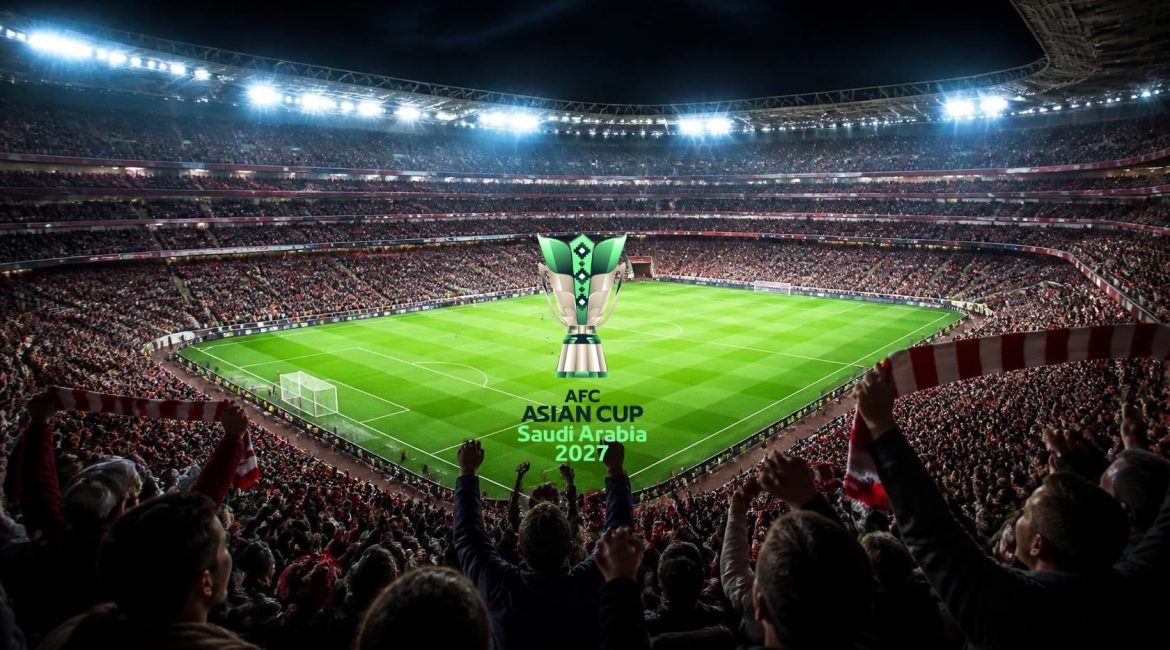
Saudi Arabia will host the AFC Asian Cup for the first time when the tournament begins on 7 January 2027. With the draw complete and all 24 teams confirmed, attention has shifted to the group-stage fixtures, the three host cities and the challenges awaiting Asia’s established and emerging national teams.
The 19th edition runs until 5 February, when the final will be played in Riyadh. Among the group-stage storylines are an all-Arab opening group, a meeting between Japan and defending champions Qatar, and Yemen’s return to the continental tournament.
Asian Cup 2027 dates and format
The competition features 24 teams divided into six groups of four. Each nation plays its three group opponents once, with the top two in every group advancing alongside the four highest-ranked third-placed teams.
That produces a round of 16, followed by the quarter-finals, semi-finals and final. The third-place qualification rule also makes results across different groups important, particularly during the final round of group matches.
| Tournament detail | Confirmed information |
|---|---|
| Host | Saudi Arabia |
| Dates | 7 January – 5 February 2027 |
| Teams | 24 |
| Groups | 6 |
| Host cities | Riyadh, Jeddah and Al Khobar |
| Matches | 51 |
| Opening match | Saudi Arabia vs Palestine |
| Final venue | King Fahd Sports City Stadium |
All six Asian Cup 2027 groups
The draw took place on 9 May 2026 in Diriyah, near Riyadh. Yemen subsequently completed the line-up by defeating Lebanon 2–0 on 4 June, taking the remaining position in Group E.
| Group | Teams |
|---|---|
| A | Saudi Arabia, Kuwait, Oman, Palestine |
| B | Uzbekistan, Bahrain, North Korea, Jordan |
| C | Iran, Syria, Kyrgyzstan, China |
| D | Australia, Tajikistan, Iraq, Singapore |
| E | South Korea, UAE, Vietnam, Yemen |
| F | Japan, Qatar, Thailand, Indonesia |
The groups create different challenges, from Saudi Arabia’s regional encounters to Japan’s meeting with the current title holders.
Group A: Saudi Arabia, Kuwait, Oman and Palestine
The hosts open the tournament against Palestine on 7 January at King Fahd Sports City Stadium. Saudi Arabia’s group also includes two familiar Gulf opponents, Kuwait and Oman, giving the opening stage a distinctly regional character.
All four teams will be playing in conditions familiar to football followers across the Gulf, but home support adds another dimension for Saudi Arabia. The meeting with Palestine will set the initial tone before the remaining group fixtures determine who advances.
Group B: Uzbekistan, Bahrain, North Korea and Jordan
Group B brings together four teams with different recent international experiences. Jordan reached the previous Asian Cup final, while Uzbekistan has continued developing its standing in Asian football.
Bahrain adds another Gulf representative to the group, and North Korea completes a combination that offers several contrasting playing styles. Uzbekistan’s meeting with Jordan is an especially interesting fixture given their recent international progress.
With third-placed qualification also available, the results of matches involving all four teams may affect the final group standings.
Group C: Iran, Syria, Kyrgyzstan and China
Iran enters Group C with its history as a three-time Asian champion. Syria, Kyrgyzstan and China complete the group, each facing the challenge of collecting enough points across three matches to reach the knockout stage.
For Iran, the tournament presents another opportunity to build on its extensive continental experience. For the other three teams, the direct encounters within the group could be particularly important when the final standings are calculated.
Group D: Australia, Tajikistan, Iraq and Singapore
Australia and Iraq bring contrasting football traditions to Group D, with their meeting providing one of its main fixtures. Both have previously won the Asian Cup, although their routes into the 2027 tournament have involved different international schedules.
Tajikistan made an impression by reaching the quarter-finals in its Asian Cup debut at the previous edition. Singapore completes the group and faces opponents with varied levels of experience in major continental tournaments.
The group offers an opportunity to see whether recent tournament experience carries into another continental campaign.
Group E: South Korea, UAE, Vietnam and Yemen
Group E is now complete. Yemen secured the final tournament place on 4 June 2026 when Nasser Al Gahwashi scored twice in a 2–0 qualifying victory over Lebanon.
Yemen joins South Korea, the United Arab Emirates and Vietnam, returning to the Asian Cup after missing the previous edition. The group brings together nations from three different parts of the continent, making it an interesting combination of regional football styles.
The UAE’s matches will attract particular attention across the Gulf, while Yemen’s return gives its supporters another opportunity to follow their national team on the continental stage.
Group F: Japan, Qatar, Thailand and Indonesia
Group F includes a notable meeting between Japan and Qatar. Japan has won the Asian Cup four times, while Qatar arrives having won the two most recent editions.
Their encounter recalls the 2019 final, when Qatar defeated Japan to secure its first Asian title. Thailand and Indonesia complete the group, with both nations also scheduled to face these established continental opponents.
Japan opens against Indonesia before playing Thailand and then Qatar. That sequence gives the final group fixture an intriguing historical context, although its competitive significance will depend on the earlier results.
Where will Asian Cup 2027 be played?
The tournament will take place across eight stadiums in three Saudi cities. Riyadh will stage matches at five venues, while Jeddah has two and Al Khobar has one.
Riyadh hosts the opening match and final at King Fahd Sports City Stadium. Its other tournament venues are King Saud University Stadium, Kingdom Arena, Imam Mohammed Bin Saud University Stadium and Al Shabab Stadium.
Jeddah will stage matches at King Abdullah Sports City Stadium and Prince Abdullah Al Faisal Sports City Stadium. Al Khobar will host fixtures at Aramco Stadium, bringing the tournament to Saudi Arabia’s Eastern Province.
The distribution of venues means teams will experience different host cities during the competition. The official match schedule identifies the stadium for each fixture, while supporters should check the tournament’s official channels for any subsequent scheduling changes.
Matches and storylines to follow
Several group-stage fixtures already carry a clear historical or regional context.
Saudi Arabia vs Palestine: The opening match begins the host nation’s first Asian Cup on home soil. It also starts a group containing four Arab national teams.
Japan vs Qatar: The fixture brings together the competition’s most successful nation by total titles and its defending champion. Their meeting also revisits the pairing from the 2019 final.
Australia vs Iraq: Two former champions meet in Group D, where Tajikistan and Singapore are also competing for qualification.
South Korea vs UAE: This match connects one of East Asia’s established national teams with a Gulf representative competing in a tournament hosted in the region.
Uzbekistan vs Jordan: Jordan’s appearance in the previous final adds context to its encounter with Uzbekistan, which has been developing its presence in international football.
These fixtures offer different reasons to follow the group stage without assuming that results will follow past records or reputations.
Which teams bring recent Asian Cup experience?
Qatar arrives as defending champion after winning the 2019 and 2023 editions. Its title defence begins in a group containing Japan, whose four Asian Cup victories remain the tournament record.
Saudi Arabia, Iran and Australia also bring previous championship experience. Jordan returns after reaching its first final in the previous edition, while Tajikistan can build on its quarter-final appearance.
Those results provide background rather than guarantees. Squad selections, preparation, injuries and performances during the tournament will determine how successfully each team translates previous achievements into its 2027 campaign.
What makes this edition significant for Gulf football?
Saudi Arabia’s first hosting of the men’s Asian Cup places the tournament at the centre of the region’s football calendar. Kuwait, Oman, Bahrain, the UAE, Qatar and Yemen also give Gulf and neighbouring football audiences several national teams to follow.
The January tournament will also overlap with the wider Asian club-football season. This creates a separate scheduling consideration for domestic clubs and their international players, a theme connected to the regional calendar discussed in our AFC Champions League Elite 2026–27 article.
The relationship between club football and national-team competition will be worth observing. Investment, squad depth and domestic-league form provide context, but the Asian Cup presents each national team with its own tournament-specific challenges.
How the group stage shapes the rest of the tournament
The six groups do more than establish the opening fixtures. Their final standings determine the round-of-16 pairings and the routes available through the knockout bracket.
The four best third-placed teams also advance, meaning a side finishing third in its group may still qualify. Goal difference and results in the final group matches can therefore matter beyond the immediate contest between two teams.
For supporters, the group-stage draw offers an initial guide to the tournament’s main storylines. Once play begins on 7 January, the results will replace those expectations with the actual knockout picture.

About Me
I have spent the past two decades immersed in the world of online gambling, building extensive experience as a casino and sports betting writer. What started as an interest in the rapidly growing digital gaming industry has developed into a long-term career focused on researching, analyzing, and explaining the constantly changing world of iGaming. Throughout my career, I have covered everything from online casino reviews and slot games to sports betting, live casino, bonuses, payment solutions, and industry developments.
After 20 years in the industry, I understand that good gambling content is about much more than simply describing a casino or a betting site. Readers need clear information, honest opinions, detailed research, and content they can trust. This philosophy is at the heart of everything I write. I combine my practical industry knowledge with SEO expertise to create content that is informative, engaging, and designed to provide genuine value to both readers and brands.
The iGaming industry continues to evolve at an incredible pace, and staying ahead requires constant learning. I closely follow new technologies, emerging markets, changing player preferences, and the latest developments across the global betting and casino landscape. My goal is simple: to use my experience and knowledge to turn complex industry information into clear, reliable, and useful content for every reader.